optoPAD, a closed-loop optogenetics system to study the circuit basis of feeding behaviors
Moreira JM, Itskov PM, Goldschmidt D, Baltazar C, Steck K, Tastekin I, Walker SJ, Ribeiro C
Manipulate neural circuits during feeding in real time. The optoPAD delivers closed-loop optogenetic stimulation triggered by the fly's own behavior.
The optoPAD extends the flyPAD platform with individually addressable LEDs positioned above each arena. When a fly interacts with food, the capacitance signal triggers LED activation in real time — creating a closed-loop system where light stimulation is contingent on the animal's behavior.
Using Drosophila expressing channelrhodopsin variants (CsChrimson, GtACR1, etc.) in specific neural populations, researchers can activate or silence neurons precisely when the fly feeds. This enables causal testing of how specific circuits influence feeding decisions.
All timing is controlled through Bonsai workflows, which can be customized to implement arbitrary stimulus protocols: continuous during feeding, pulsed, delayed onset, or conditional on specific behavioral states.
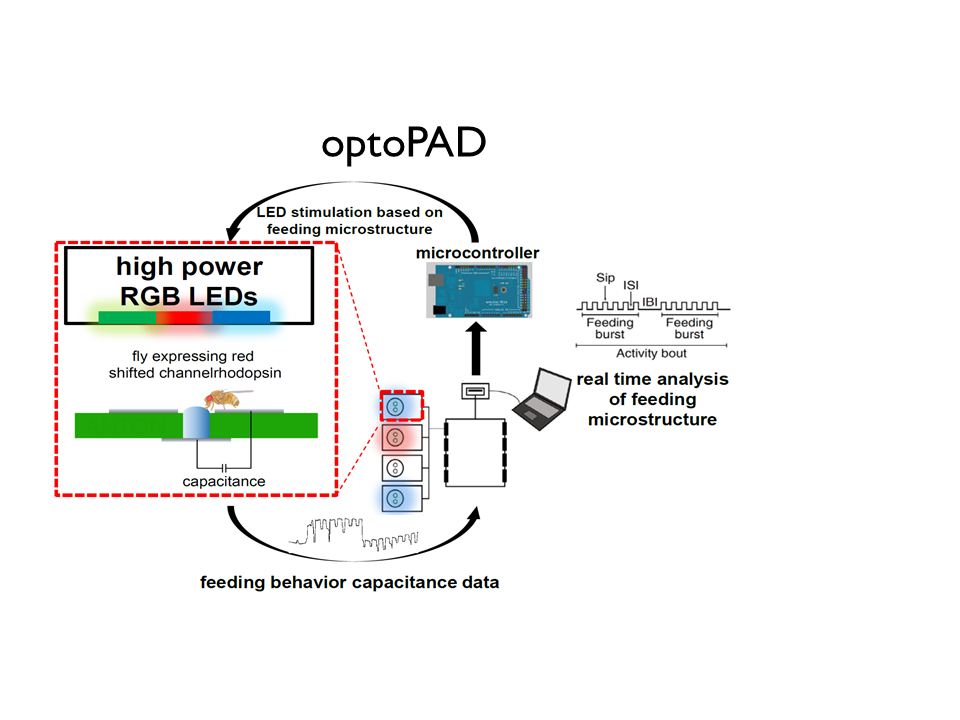
Closed-loop optoPAD: detected feeding triggers optogenetic stimulation in real time.
Example output generated automatically by the flyPAD analysis software. See the full sample analysis →
Light stimulation delivered the moment the fly feeds. These clips show closed-loop optogenetic manipulation in the optoPAD arena.
Gr66a-Gal4 › CsChrimson
Optogenetic activation of bitter-sensing neurons during feeding
C17-Gal4
Closed-loop LED stimulation triggered by the fly’s own feeding
Control
Feeding in the optoPAD arena without optogenetic stimulation
Combine behavioral readout with neural manipulation in a single experiment.
Compare feeding behavior with and without optogenetic activation of target neurons.
Measure how behavior-contingent stimulation changes feeding patterns vs. open-loop.
Pair stimulation with one food to test whether neural activation shifts preference.
Time between neural activation onset and changes in feeding motor program.
How optogenetic activation alters sip duration, burst structure, and bout timing.
Vary light intensity or pulse frequency to map activation thresholds for behavioral change.
Moreira JM, Itskov PM, Goldschmidt D, Baltazar C, Steck K, Tastekin I, Walker SJ, Ribeiro C
Get a quote for the optoPAD system to study neural circuits underlying feeding behavior.