Automated monitoring and quantitative analysis of feeding behaviour in Drosophila
Itskov PM, Moreira JM, Vinnik E, Lopes G, Safarik S, Dickinson MH, Ribeiro C
Go beyond total food intake. Analyze the fine-grained temporal structure of feeding behavior — sip duration, burst patterns, and inter-bout intervals.
At 100 Hz sampling, the flyPAD captures not just whether a fly feeds, but exactly how it feeds. Each proboscis extension generates a capacitance trace with precise onset and offset times, enabling decomposition of feeding into its motor components.
Individual sips cluster into bursts (rapid sequences of sips), which are separated by inter-burst intervals. Bursts themselves group into feeding bouts, separated by longer pauses. This hierarchical structure reveals information about feeding motivation, sensory processing, and motor control.
Microstructure analysis can detect subtle pharmacological or genetic effects that are invisible to bulk measures of total food intake.
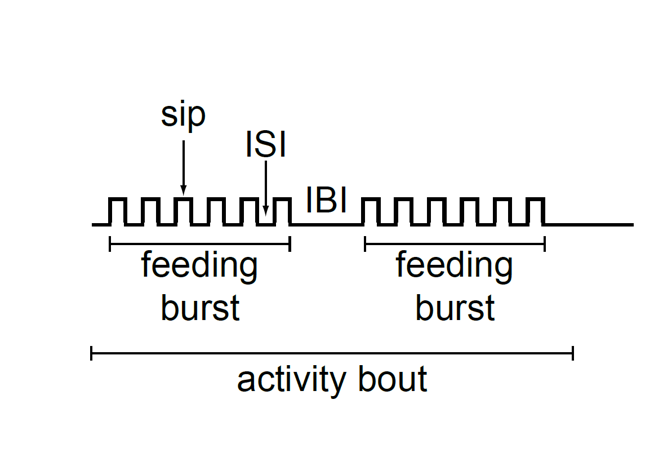
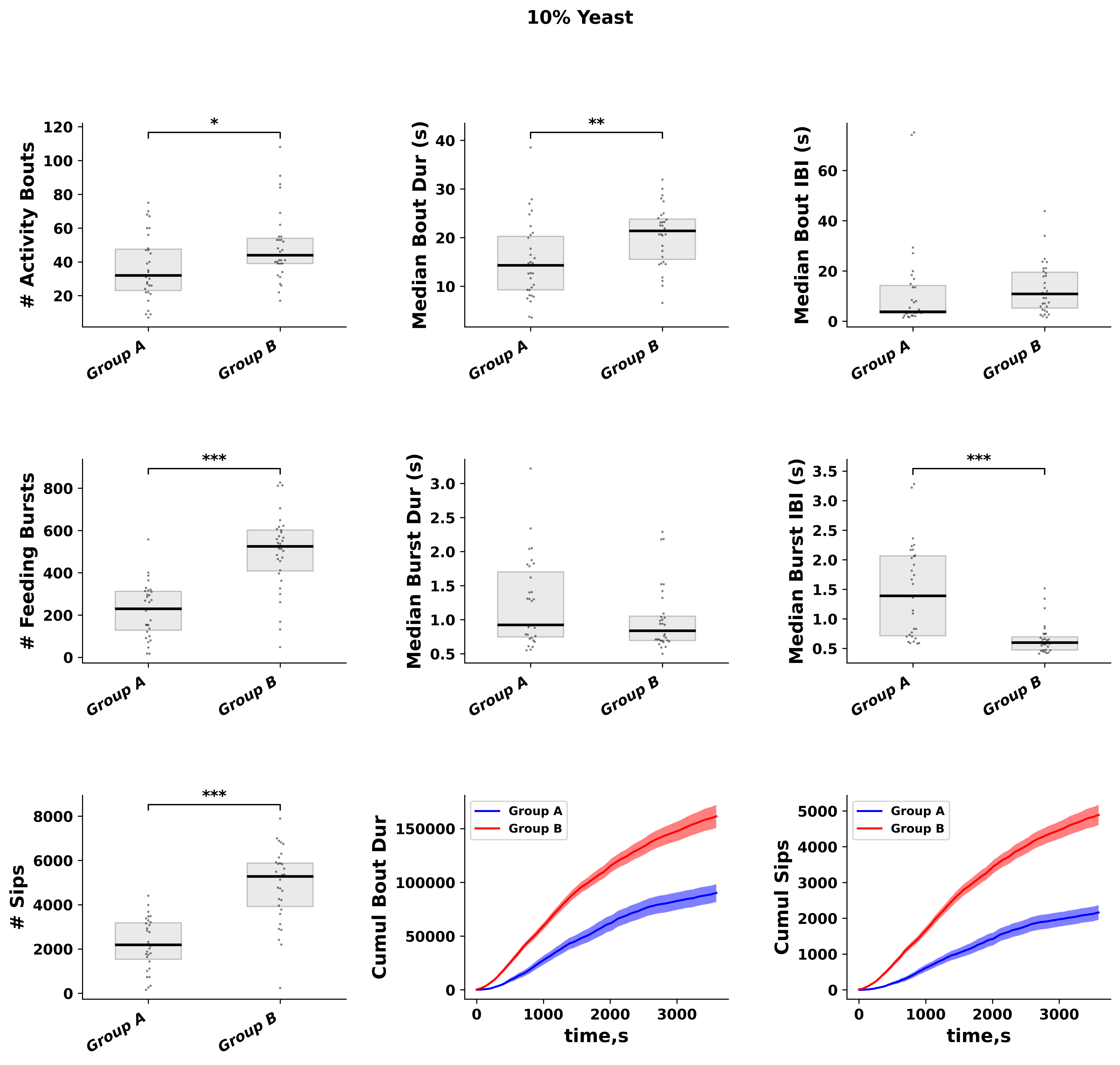
Feeding microstructure: activity bouts, feeding bursts, and sip counts.
Example output generated automatically by the flyPAD analysis software. See the full sample analysis →
Decompose feeding into its fundamental motor components.
Length of individual proboscis-food contact events, measured in milliseconds.
Number of consecutive sips within a rapid feeding burst.
Pauses between bursts, reflecting sensory evaluation and satiation signals.
Length of sustained feeding episodes before the fly disengages from food.
Longer pauses between feeding bouts, indicative of satiation state.
Overall feeding motor program structure, useful for neurogenetic dissection.
Itskov PM, Moreira JM, Vinnik E, Lopes G, Safarik S, Dickinson MH, Ribeiro C
The flyPAD captures every detail of feeding motor programs. Get a quote to start your microstructure experiments.